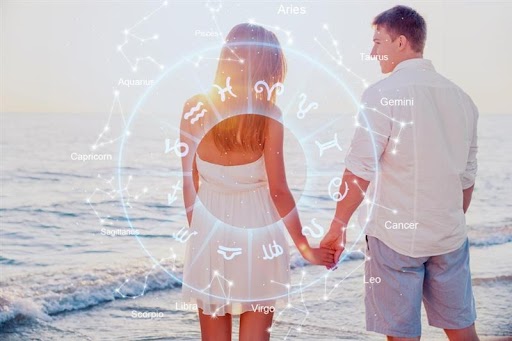
Marriage is not just a partnership on paper; it is a bond that remains unbroken even after they are gone. A union that develops with time, where both individuals share everything, and fight to make each other the best version of themselves. Everyone desires a special partner who will hold their hand till the end of this world. But the question remains, when? When will that special someone enter my life? When will I get married? These are some common questions that arise in discussions about marriage. And naturally, this leads to another interesting question: Can a birth chart predict marriage?
Whether the answer is yes or no, astrology is still a helpful way to understand different parts of your life. So, let’s explore how it can guide us and find the answers to our questions about marriage prediction.
Predicting Marriage Through Astrology
Marriage prediction is a detailed process in Vedic astrology. It involves studying things like planetary movements, house positions, doshas, divisional charts, yogas, and transits to understand the possible time and type of marriage. But with so many factors to look at, it is easy to feel unsure about what actually applies to you.
This is why many individuals look for guidance from experts who can simplify these insights and explain what the stars say about their marital lives. To get answers quickly and conveniently, they can connect directly with a professional astrologer. Nowadays, due to rising tech, astrology has also become tech friendly and many online astrology guidance options are available and that too for free. So, a free online chat with astrologer is also an option. Where they can ask questions, clear doubts, and receive personalized marriage predictions and interpretations tailored to their birth chart, all without the inconvenience of leaving their home.
Now, let’s have a look at the key ideas and forecasting approaches astrologers employ to predict marriage.
The 7th House and Its Lord
The seventh house, which stands for partnerships, love, and marital happiness, is the main sign of marriage in Vedic astrology. A thorough study of this house can give a structure for marriage predictions. Key elements include:
- The sign in the seventh house and its governing planet (7th lord).
- Any drishti or planetary aspects, it receives.
- The presence of either good or bad planets.
Benefic influences typically favor timely and harmonious partnerships, but malefic elements or occupants might indicate delays, disagreement, or unusual pairings.
The 7th Lord’s strength and position in the natal chart are crucial. If the 7th lord appears in a Trikona (trinal house) or Kendra (angular house), and possesses its own, exalted, or favorable sign, it favors marriage, particularly during its planetary era (Dasha). Conversely, if it is weak or combust or located in unlucky houses (8th, 6th, 12th), marriage may be postponed or problematic.
The Significator of Marriage: Venus
In Vedic astrology, Venus plays a major role as the karaka (significator) of relationships, marriage, passion, and sexual pleasure. Across classical texts, Venus is consistently associated with the 7th house, which governs partnerships and marital life. Venus’s position in each house has an influence on marriage outcomes. For instance:
- Venus in the first or seventh house frequently denotes physical attraction, deep romance, or a lovely spouse, though the results differ depending on the ascendant.
- Venus in the sixth or eighth house might cause frustration, disagreements, or a lack of physical satisfaction.
- Problems like postponed delivery, financial hardship from a partner, or emotional discontent might arise from a troubled Venus.
- Venus in the second or fourth house indicates marital stability and increased wealth after marriage.
Venus-related dashas and antardashas have a profound influence on marriage timing. If Venus is favorably placed, these times may suggest marriage and marital happiness. On the opposite side, when they are debilitated or afflicted, they might cause distress or separation.
Dashas and Antardashas
The Vimshottari Dasha technique is an important approach in Vedic astrology for scheduling events like marriages. Each person’s life is split into Dashas (planetary periods) and Antardashas (sub-periods), which unfold based on the Moon’s placement at birth. Marriage is frequently likely when Dashas include Venus, the natural significator of relationships, or planets in the 7th house, which is the house of marriage.
Old texts focus on favorable Dasha-Antardasha pairings, such as:
- The Moon’s or Venus’ Antardasha during the Sun Dasha.
- Venus’s Antardasha in the Moon’s Dasha.
- The Moon’s Antardasha in Mercury Dasha.
These combinations are more effective when the Dasha lords are exalted, in their own sign, or in favorable signs with no malefics.
Another important factor is the starting planet of a new Dasha. If it is positively associated with marriage, such as the seventh Lord or Venus, it can open the way for a union during that Dasha.
Ultimately, Dasha-based forecasts gain weight when backed up by alignment in the natal chart and beneficial transits. Marriage is more likely to happen when the Dasha-Antardasha coincides with Jupiter or Saturn transits influencing the 7th house.
Conclusion
In Vedic astrology, marriage is predicted by looking at the whole birth chart along with planetary periods (Dashas), yogas, and planetary movements (transits). The 7th house, the planet that rules this house, and Venus play the biggest role in showing the chances and type of marriage. The timing of marriage is usually supported by positive Dashas and the movement of planets like Jupiter and Saturn.
Finally, accurate marriage prediction necessitates combining these several layers of analysis. When understood collectively, they provide an in-depth knowledge of both the when and what kind of marriage experience one might expect.